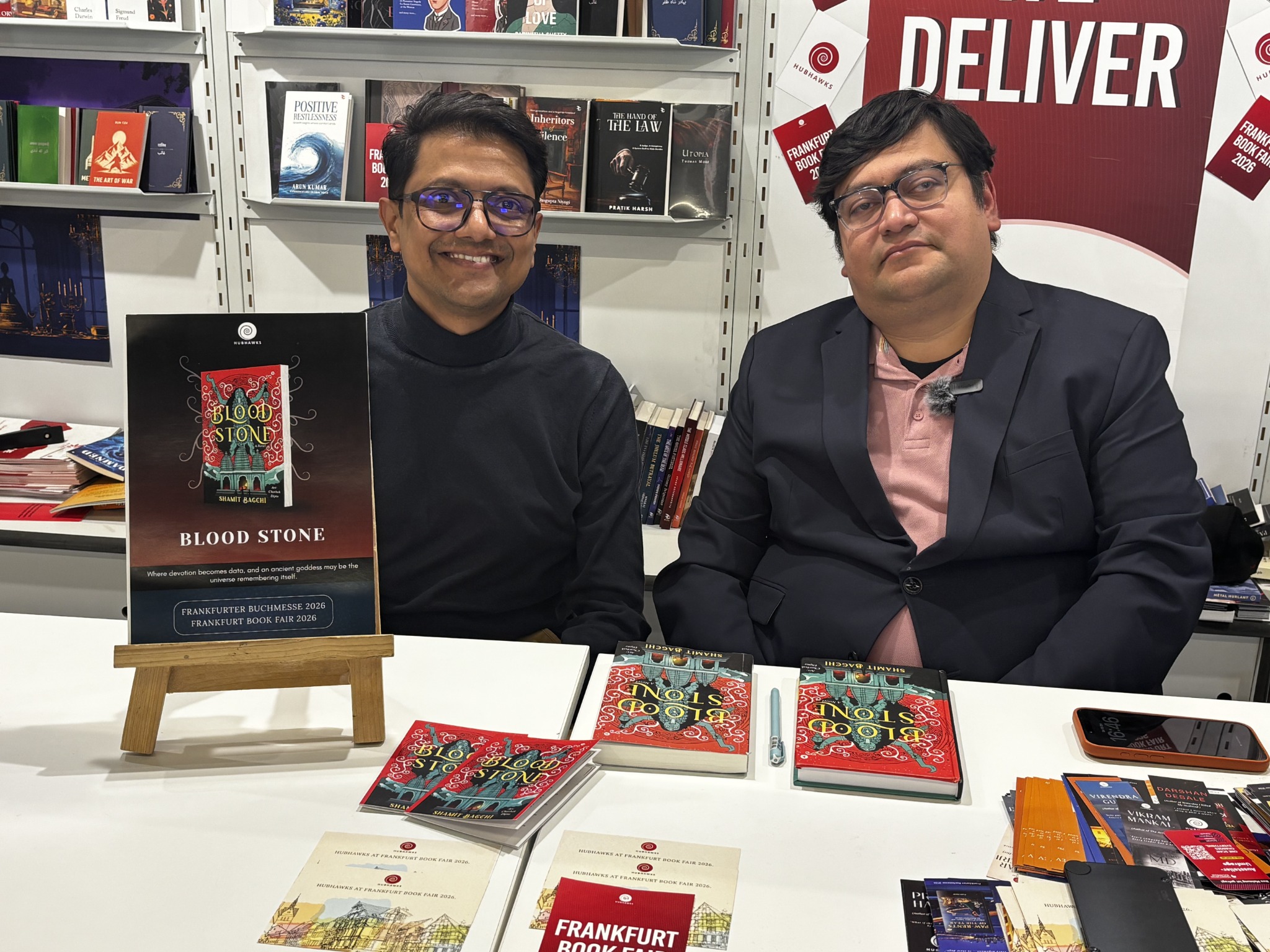
What happens when the demands of modern life begin to overwhelm the people trying to navigate it? In Pratik Harsh’s fiction, the answer takes two very different forms: a marriage strained by ambition and a justice system where technology threatens to determine the truth. At the Frankfurt Book Fair 2026, Hubhawks represented both Paw-Rents of the Year and The Hand of the Law, with Harsh present in person to represent his work at the international publishing event.
In Paw-Rents of the Year, Harsh turns his attention to the pressures of modern relationships, setting his story in Mumbai. Ishu and Neeti Singh appear to have built the enviable life that professional success promises. He negotiates media mergers, she fights Bollywood’s legal battles, and their sea-facing Bandra apartment reflects their achievements. Yet beneath the polished exterior, their marriage has become a routine of post-it notes, notifications and conversations squeezed between demanding careers. The household’s three dogs, each with a distinct personality, often seem to command more attention than the couple themselves.
Their carefully organised lives are disrupted during an anniversary weekend in Lonavala, when a monsoon storm cuts both the power and the signal. With no Wi-Fi or work to retreat into, Ishu and Neeti are left confronting the distance that has grown between them. Candlelight, ruined pasta and an unexpected pause in their routines create the conditions for a different kind of conversation. The novel uses humour and domestic chaos to explore a familiar question: how much of a relationship can be lost when two people become consumed by the lives they are trying to build?
With The Hand of the Law, Harsh moves from the intimacy of a marriage to the institutional pressures of a near-future justice system. Set in a fully digitised New Delhi, the legal techno-thriller follows Justice Amitabh Sanyal as he takes up a sensational murder case involving two impoverished labourers accused of killing a wealthy family. What initially appears to be a criminal investigation becomes more complicated when Sanyal discovers that digital evidence has been manipulated and crucial forensic findings erased.
As he pursues the case, the investigation exposes links between corporate interests, political machinery and the judiciary. The novel raises questions about the reliability of systems designed to make justice more efficient, particularly when the technology underpinning them can also determine which evidence survives. At its centre is a troubling possibility: if the institutions responsible for establishing truth depend on systems that can be manipulated, what happens to justice itself?
The book has also received interview coverage from Dr. Marissa Pei, whose work as a talk-show and podcast host includes author interviews and book features. The conversation around The Hand of the Law adds another platform for Harsh’s exploration of technology, evidence and the future of justice.
Although the books occupy different genres, they share an interest in the structures that shape modern life. Paw-Rents of the Year explores how professional ambition and everyday distractions can interfere with personal relationships. The Hand of the Law examines what happens when institutional power and digital systems threaten the integrity of justice. One looks at the private consequences of being perpetually occupied; the other considers the public consequences of allowing technology to influence what can be known and proved.
Harsh brings professional familiarity to both settings. He leads Business and Legal Affairs for Condé Nast, a role that gives him direct experience of a demanding professional environment. His earlier work, A Wisdom to IPR, is a reference in National Law University libraries, while Paw-Rents of the Year has drawn warm reviews since its release.
Through its representation of both books at Frankfurt 2026, Hubhawks presented two distinct sides of Harsh’s storytelling, with the author himself present at the fair. From the personal negotiations of a Mumbai marriage to the systemic challenges of a digitised courtroom, the books examine different forms of pressure, responsibility and accountability. Together, they ask readers to consider what happens when the systems people build—whether around their careers, relationships or institutions—begin to take precedence over the very human realities they are meant to serve.